| Adam Clarke | ||||||||||
|
About the Author
As a theologian, Clarke reinforced the teachings of Methodist founder John Wesley. He taught that the Bible provides a complete interpretation of God's nature and will. He considered Scripture itself a miracle of God's grace that "takes away the veil of darkness and ignorance."1 With such an understanding, Clarke was first and foremost a Biblical theologian, often uneasy with purely systematic approaches to theology. Adam ClarkeClarke followed Wesley in opposing a Calvinistic scheme of salvation, preferring instead the Wesleyan-Arminian positions regarding predestination, prevenient grace, the offer of justification from God to all persons, entire sanctification, and assurance of salvation. Perhaps his most controversial position regarded the eternal Sonship of Jesus. Clarke did not believe it Biblically faithful to affirm this doctrine, maintaining that prior to the Incarnation, Jesus was "unoriginated." Otherwise, according to Clarke, he would be subordinate to God and therefore not fully divine. This was important to Clarke because he felt that Jesus' divinity was crucial to understanding the atonement. Clarke's view was opposed by many Methodists, notably Richard Watson. Watson and his allies argued that Clarke's position jeopardized the integrity of the doctrine of the trinity. Clarke's view was rejected by Methodism in favor of the traditional, orthodox perspective. |
||||||||||
|
||||||||||
|
||||||||||
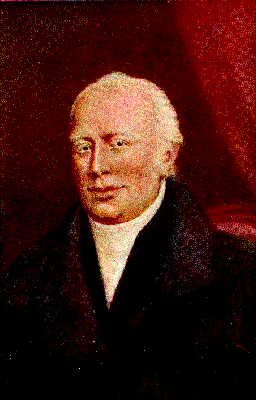 Adam
Clarke (1760 or 1762–1832) was a British Methodist theologian and
Biblical scholar. He is chiefly remembered for writing a commentary on
the Bible which took him forty years to complete and which was a primary
Methodist theological resource for two centuries.
Adam
Clarke (1760 or 1762–1832) was a British Methodist theologian and
Biblical scholar. He is chiefly remembered for writing a commentary on
the Bible which took him forty years to complete and which was a primary
Methodist theological resource for two centuries.


 |
 |
 |
||
 |
 |
 |
||
 |
 |
 |